You paste a twenty-page report into ChatGPT and ask for a summary. What comes back is accurate, tidy and completely useless for the meeting you're walking into in ten minutes. So you try again with more words, and get a longer version of the same thing.
It's tempting to blame the model. Usually the model did exactly what it was asked. The request just left too much open, and the gaps had to be filled with something — so they were filled with the most average answer available.
The fix isn't prompt engineering, and it isn't a framework with an acronym. It's closing the gaps that force a guess. Three questions close most of them.
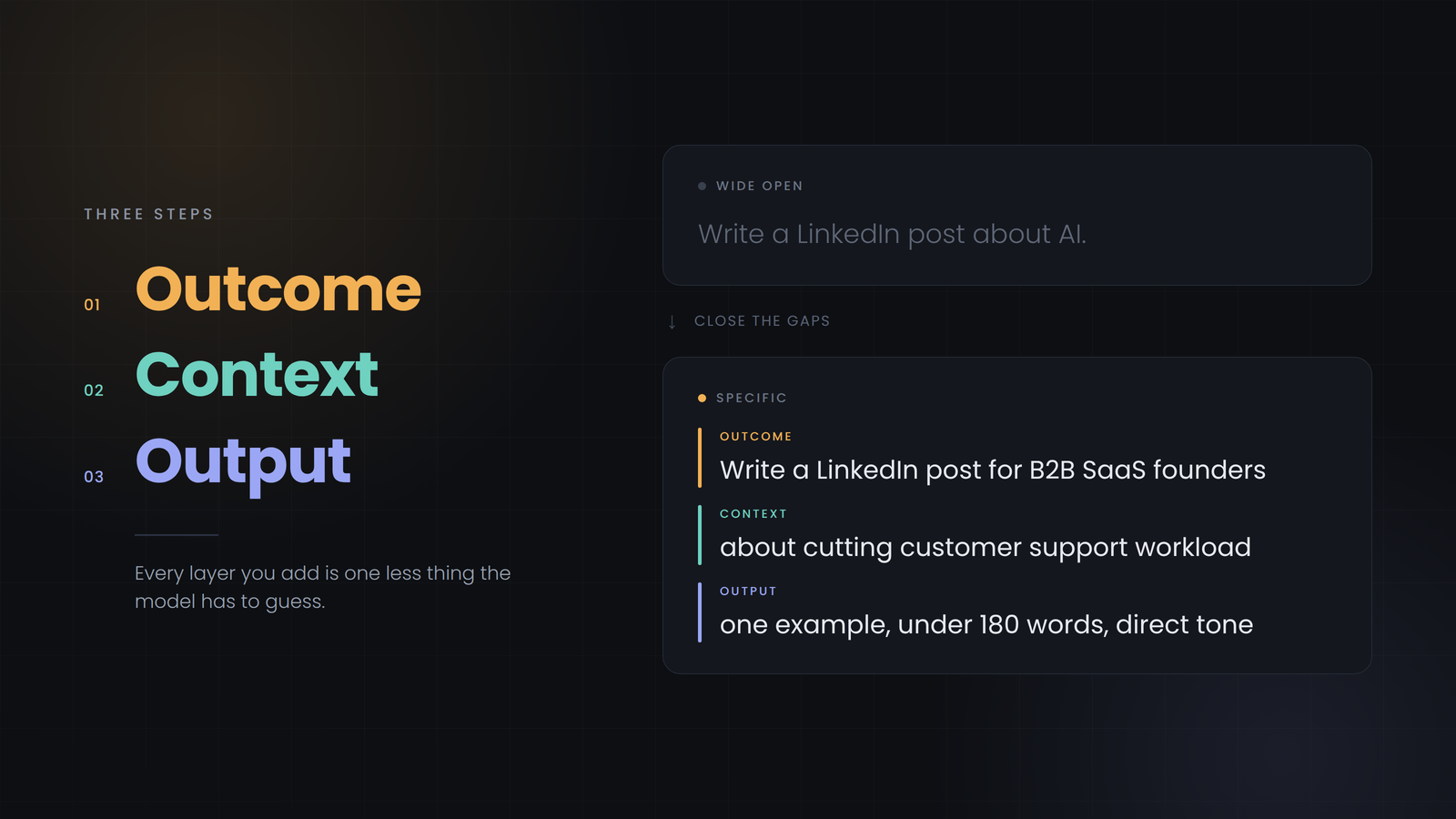
Watch what happens to a request that's technically clear but wide open:
Write a LinkedIn post about AI.
Now compare it with this:
Write a LinkedIn post for B2B SaaS founders about using AI to cut customer support workload. Focus on one specific problem, include one practical example, keep it under 180 words, and use a direct, conversational tone.
Same task. The second one has almost nothing left to guess about. That's the whole game.
Step 1: Start from the thing you want to exist
Before you type anything, answer one question: what do I want to have when this is finished?
Not "help me with marketing" but "five content ideas for a B2B SaaS company". Not "help me with this presentation" but "a ten-slide structure for introducing our new product to prospects". The first version of each names a territory. The second names a result.
This matters more than it sounds, because AI will respond to nearly anything. Hand it a territory and it has to decide, on your behalf, what a useful answer looks like — and its idea of useful is an average of everything it has ever read on the subject. Hand it a result and that decision is already made.
You don't have to explain the whole situation yet. Just name the destination.
Step 2: Add what you'd need to know yourself
Now a different question: if you handed this task to a competent freelancer, what would they have to ask you before they could start?
That list is your context. Usually some of:
- who it's for
- what you're working on, and where this fits into it
- what you're actually trying to achieve
- background the AI has no way of knowing
- text or data it should work from
- an example of what "good" looks like to you
- constraints it has to respect
"Write a product description" says very little. "Write a product description for a lightweight running shoe aimed at casual runners" puts a situation around it. Add "focus on making it feel comfortable and practical for everyday training" and now it has a direction to push in.
One warning, because this is where people overcorrect: length is not the point. A prompt padded with background that doesn't change the answer is just a slower prompt. Before you add a sentence, ask whether the response would be different without it. If it wouldn't, cut it.
Step 3: Describe the finished result
Last question: what should the answer look like when it arrives?
Format, length, tone, structure, how many options, what to include, what to leave out. "Give me five ideas" is clear enough, but it still leaves a dozen small decisions open. How long is each one? Is there a title? Does it say who the idea is for?
Compare it with this: "Give me five ideas. For each one: a title, a one-sentence description, and who it's for. Under 50 words each."
Now the output is predictable, which matters most when this is something you'll be doing again next week. You're not telling the AI how to think. You're telling it what a useful result looks like when it's done.
All three on one request
Start somewhere vague:
Write a LinkedIn post about remote work.
Outcome. "Write a LinkedIn post about remote work for our company page."
Context. "… Our audience is managers of distributed teams, and we want to tackle the problem of remote meetings that go nowhere."
Output. "… Open with the problem, give one practical example, end with a question. Under 180 words, direct and professional."
Each pass removes a layer of guesswork. Nothing about it is clever. It's just specific.
A formula worth reusing
When you're not sure where to start, start here.
| Part | The question it answers |
|---|---|
| Outcome | What do I want to have at the end? |
| Context | What does it need to know that it can't work out on its own? |
| Output | What should the finished answer look like? |
| Audience | Who is this for, and what do they already know? |
| Constraints | What does it have to respect, or avoid entirely? |
Put together, that reads like this: "Create a content calendar for a B2B SaaS company. We're launching an analytics feature for small business owners and want to build awareness over the next month. Give me 12 ideas in a table with topic, audience, format and goal."
You don't need to get it right first time
The most common mistake isn't writing a vague prompt. It's trying to write a perfect one — sitting there composing the ideal instruction before you press enter.
Don't. Name the outcome, add the context that matters, say what the output should look like, and send it. Then read what comes back and fix the one thing that's wrong:
The examples are too generic. Use ones from B2B SaaS instead.
Keep the structure, but make the recommendations more concrete.
A follow-up message costs you ten seconds. Trying to predict every possible failure in advance costs you five minutes and usually misses the real one anyway.
Where this stops working
Worth being honest about the limits, because more context isn't always the answer. Three situations where specificity won't save you:
The task needs a judgement you haven't made yet. If you don't know whether the post should sound defensive or confident, no amount of context will decide it for you, and the AI will simply pick one. Decide first, then prompt.
The information isn't there to be had. Internal numbers, what a competitor announced yesterday, the way your team actually talks in meetings. Specificity doesn't create knowledge. You have to supply it, or connect a source that has it.
The prompt is doing too many jobs at once. When a request has grown to four paragraphs and the answer still keeps dropping one requirement, more detail usually makes it worse. Split it into two prompts and run them in sequence.
The short version
Before you send a prompt that matters, three checks. Did I say what I want produced? Did I give the information that would change the answer? Did I say what the result should look like?
Outcome, context, output. You don't need to write longer prompts. You need to hand over better information.