Everyone tells you to give AI more context. Almost nobody tells you which context — and the wrong kind makes the answer worse, not better.
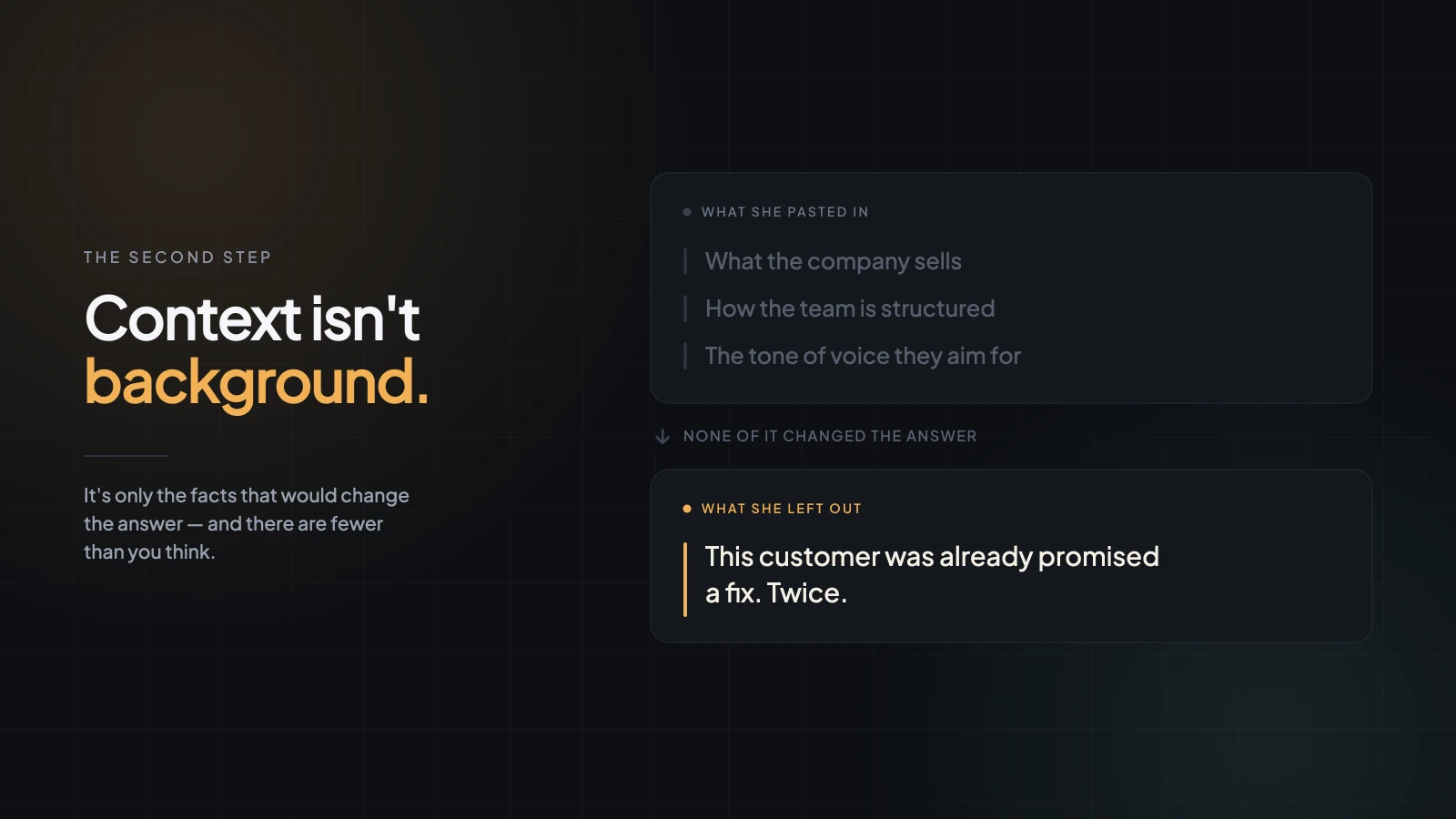
A friend of mine runs support at a small software company. She'd read, more than once, that the trick to getting something useful out of ChatGPT is context. So she gave it context: three paragraphs about the company, what it sells, how the team is structured, the tone they try to hit. Then she asked for a draft reply to an angry customer. What came back was still generic, still slightly wrong, and now also longer.
She showed me the prompt. Every one of those three paragraphs was true, and not one of them mattered. What the model needed was a single line she hadn't thought to include: this customer had already been promised a fix twice, by two different people.
That's the trouble with "add context" as advice. It sounds actionable and isn't. Context is not background. It's the set of facts that would change the answer — and there are usually far fewer of them than the word suggests.
Context is the middle step of the three-step method: say what you want, give the context, describe the output. It's also the step people get wrong most often, which is why it's worth slowing down on.
One test tells you whether something is context
Take a sentence you were about to include, and delete it. Would the answer come back different?
If yes, keep it. If no, it isn't context — it's padding. And padding isn't harmless. A model reading four paragraphs has to work out which parts matter, and that is precisely the decision you were trying to make for it. Bury "promised a fix twice" inside a company profile and it gets weighted like everything else around it.
This is why short prompts often beat long ones, which tends to surprise people who have been told to write more.
What actually counts as context
Three kinds of thing pass that test reliably.
The situation. What has already happened that the model has no way of knowing. The customer has emailed three times. The deadline moved. The person you're writing to turned this idea down last quarter. This is the category people skip most often, because it's so obvious to them that it stops feeling like information.
The material. The actual text, numbers or examples the task operates on — pasted in, not described. More on this below, because it's where most prompts quietly fail.
What you've already tried. If you've had two attempts at this and both came back too formal, say so. Otherwise you're about to get a third.
Notice what isn't on that list. Who the answer is for is real and it matters, but it's audience, not context, and it's worth keeping the two apart in your head. You can have perfect context and still pitch it at entirely the wrong person.
The mistake almost everyone makes
Describing the material instead of pasting it.
Rewrite my homepage headline to be clearer.
The model has never seen your homepage. It will invent a headline, and the invented one will be perfectly fine and completely generic, because it's answering a question about headlines in general rather than about yours in particular.
Here's my current homepage headline: "Workflow automation for modern teams." Rewrite it so a first-time visitor understands what the product actually does within about five seconds. We automate approval chains — expenses, time off, purchase requests — for companies between 50 and 500 people.
Same request. The only difference is that the second one contains the thing being worked on.
This happens more widely than it sounds. "Summarise my meeting notes," without the notes. "Improve this paragraph," with no paragraph attached. "What do you think of my pricing?" with no prices. Every time, the model answers the general version of your question — and the general answer is the one that reads as generic.
The opposite mistake
Having learned that context helps, people start pasting everything: the full email thread, the whole document, four quarters of numbers, the complete brand guideline.
This fails in a quieter way. The model doesn't ignore the extra material; it averages across it. Give it the entire thread and it will weigh a throwaway line from six weeks ago against the sentence that actually matters, because nothing in the prompt told it which was which.
There's a simple division that keeps this manageable. Paste the material, summarise the history. The thing being worked on goes in whole — the email you're replying to, the paragraph you're fixing, the numbers you're analysing. Everything around it gets compressed down to the lines that would change the answer.
Before and after, on something ordinary
Here's a request with no context at all:
Write a reply to this customer complaint.
And here's the same request with the three kinds above:
Reply to the email below. Background: this customer reported the same sync bug on 2 September and was told it would be fixed in the next release. It wasn't. This is their third email and the tone has changed. We do have a fix going out on Friday, and I don't want to promise anything beyond that date. I've already tried a version that opened with an apology and it read as insincere — start with what we actually did instead.
Nothing in that second prompt is clever. It took about forty seconds to write, and most of it is just saying out loud what the person already knew and hadn't thought to mention.
When context isn't the problem
Three failures that more context won't touch, because it's worth recognising them before you spend twenty minutes writing a longer prompt.
You haven't decided yet. If you don't know whether to hold the line on the refund or offer one, no amount of situation will decide it for you. The model will pick, and it will pick arbitrarily. Decide first.
The material is the problem. If the meeting notes are three bullet points of shorthand, no framing will turn them into a decision log. Context can't add information that was never captured.
It's an output problem in disguise. When the answer is accurate but three times too long, or in prose when you needed a table, adding more background makes it worse. That's the third step, not this one.
The short version
Context isn't everything you know about the situation. It's the part that would change the answer. Paste what's being worked on, say what already happened, mention what you've already tried, and cut anything you could remove without the output moving.
And if you can't tell whether a sentence earns its place, take it out and run the prompt both ways. The model will tell you.