A correct answer in the wrong shape costs you more than a wrong one — because you have to read all of it before you find out.
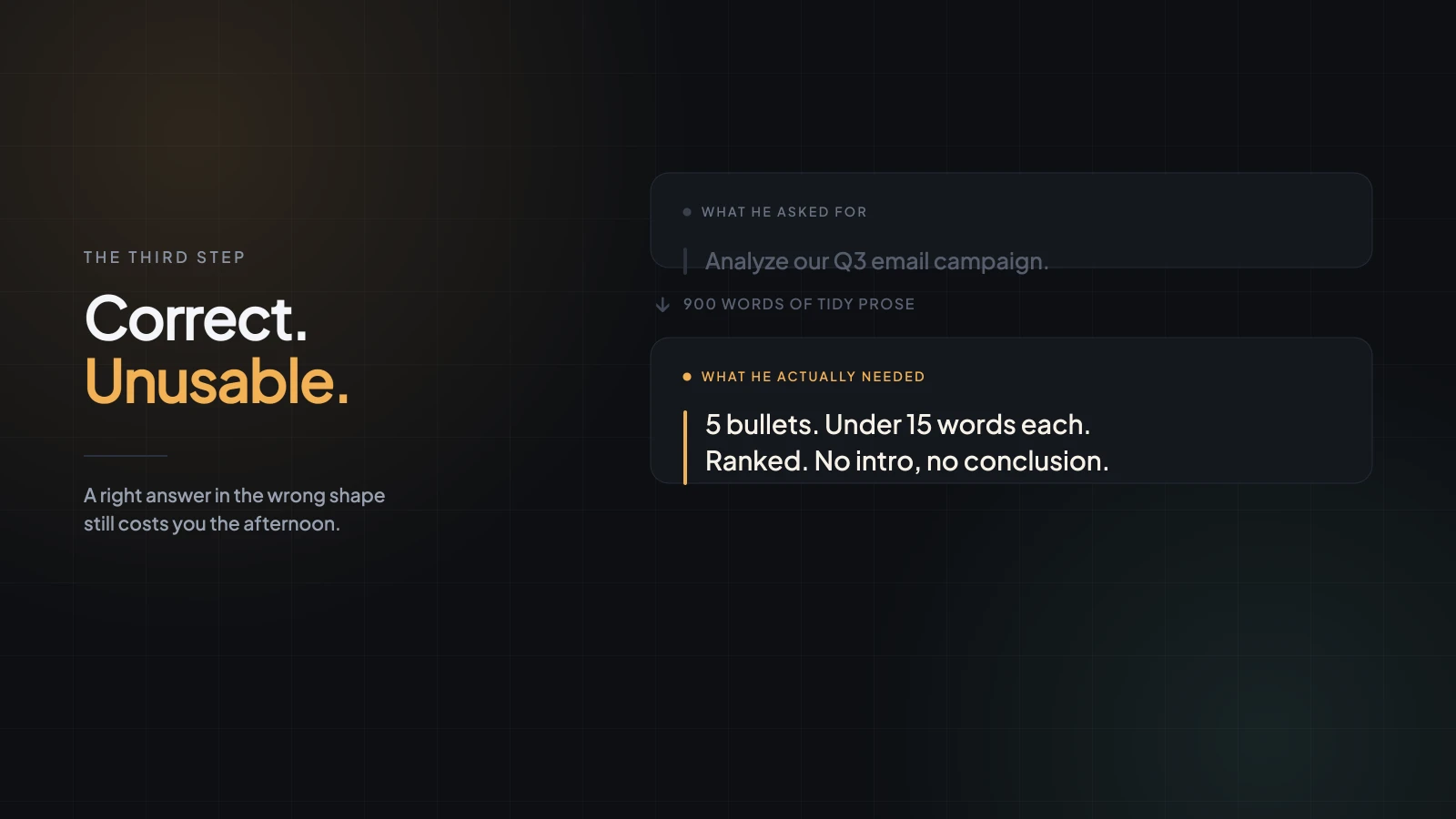
A marketing manager I know asked ChatGPT to analyze the results of last quarter's email campaign. What came back was nine hundred words of well-organized prose. Accurate, readable, and useless: he needed five bullet points for a slide that was due in an hour.
So he read all nine hundred words to pull them out. That took longer than writing the five bullets from the dashboard himself would have.
Nothing went wrong there, exactly. He asked for an analysis and got an analysis. He just never said what an analysis was supposed to look like by the time it reached him, so the model decided on his behalf — the way it always does when you leave a decision open.
Output is the third step of the three-step method: say what you want, give the context, describe the output. The first two decide whether the answer is correct. This one decides whether you can use it.
Most people name the subject and leave the shape blank
Look at how the request actually gets typed:
Analyze the results of our Q3 email campaign.
Every word there is about the topic. Not one is about the artifact. How long is it? Prose or a table? Does it rank the findings or just list them? Does it include recommendations, or only what happened? Should it mention the metrics that stayed flat?
Five open decisions, and the model will close all five — reasonably, by averaging what an "analysis" usually looks like. That average is a few hundred words of balanced prose, which is the right shape for almost nothing anyone actually does at work.
Output is four decisions, not one
People hear "specify the output" and add the word concise, which closes none of them. Four things are worth naming, and most prompts need only two or three.
The container. A table, a bulleted list, an email, three options, a one-page brief, a slide outline. This is the highest-value word in most prompts and the one most often missing.
The size. Not "short" — a number. Five bullets. Under 120 words. Three options. "Short" is a feeling. 120 is something the model can check itself against while it writes.
The structure. What each unit contains, and when it repeats. "For each idea: a title, one sentence, and who it's for." This is what turns a list into something you can paste into a document without reformatting it first.
What to leave out. No preamble. No restating my question. No closing paragraph about consulting a professional. Every model has habits, and naming the one that annoys you costs four words.
If you only ever add one of the four, add the container. It's a single noun, and it closes more of the uncertainty than the other three put together.
Before and after, on a real deliverable
Here's that campaign request again, with the output described:
Analyze the results of our Q3 email campaign, pasted below. Return five bullet points for a slide: each one a finding in under 15 words, ranked by how much it should change what we do next quarter. Put the number in the bullet where a number helps. No introduction, no conclusion, no recommendations section — I'll write those myself.
Twenty seconds longer to type. What comes back is either usable as it stands or obviously wrong at a glance, and that second part is the underrated half of the deal: a defined output means you can judge the answer in five seconds instead of reading to the end to find out.
The same thing works at much smaller sizes. "Write a LinkedIn caption for this post" gets you something serviceable and immediately forgettable. "Three caption options, under 40 words each, no hashtags, and don't end on a question" gets you something to choose between — and choosing between three is a thirty-second job, where fixing one is a ten-minute one. Two of the four decisions are doing all of that work: the container and the exclusion.
Describe the artifact, not the task
There's a move that helps when you can't picture the shape yet. Instead of describing what you want the model to do, describe the thing you want to be holding when it's done.
"Help me prepare for the client call" is a task, and it will get you a page of general advice about client calls. "A one-page brief: the three things they care about, the two questions they're most likely to ask, and the one number I should know cold" is an artifact. Same preparation, but now there's something to hand back.
The useful side effect is that it forces the decision onto you. Fairly often you'll find you don't yet know what you want — which is much better to discover before you spend ten minutes reading an answer that was never going to fit.
When the output isn't the problem
Three cases where describing the shape more precisely won't help, worth recognizing before you rewrite the prompt a fourth time.
You're thinking, not producing. Early on, an open answer is the point — you want the angles you hadn't considered, not five tidy bullets. Say that instead: "think out loud, don't structure this yet" is an output spec too.
The shape is right and the content is thin. If the table has the columns you asked for and nothing worth putting in them, that's a context problem wearing an output costume. The model can't format its way to information it was never given.
You need the answer to be checkable. Format doesn't make anything true. When correctness matters, say how you'll judge it and ask the model to flag what it was unsure about — a different move from shaping the output, and the one most people never make. A well-formatted table of confident-sounding numbers is the most expensive kind of wrong answer there is.
The short version
Name the container. Name the size, as a number. Name the structure when it repeats. Name the one thing you don't want. Four short phrases, twenty seconds, and the difference between an answer you use and an answer you rewrite.
And if you can't describe the artifact, that's information too. You haven't decided what you want yet, and no prompt fixes that.