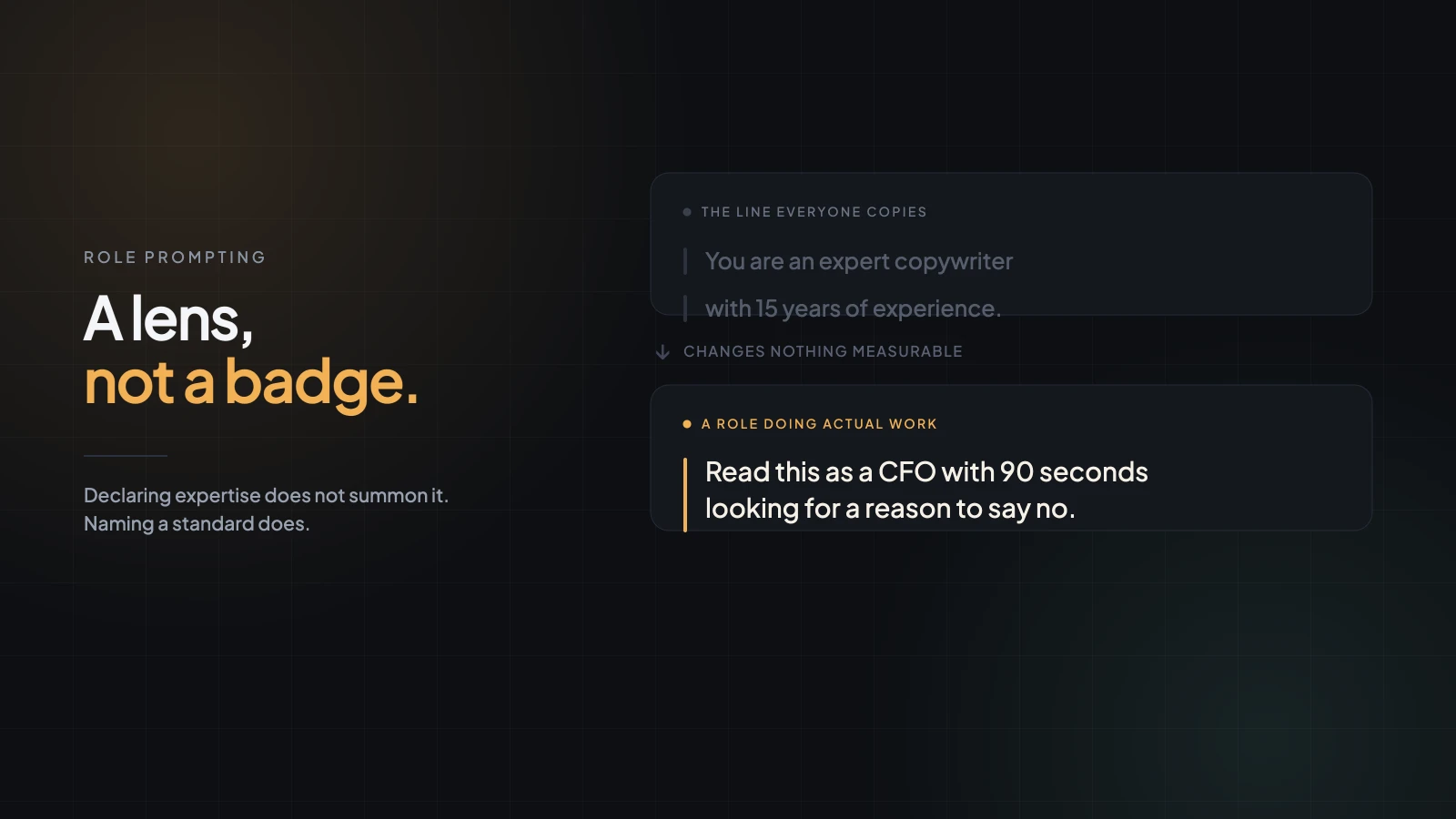
"You are an expert copywriter with 15 years of experience" is the most copied line in prompting, and most of the time it does nothing at all.
Almost everyone who has read anything about prompting has a template that opens with a job title. You are a senior marketing strategist. You are a world-class editor. You are a financial analyst at a top firm.
Try this once: take that line out of a prompt you use regularly, run it both ways, and compare. For most everyday requests you will not be able to tell which answer came from which — which means the line was costing you a sentence and buying you nothing.
That doesn't make role prompting useless. It makes it narrower than its reputation. It's worth knowing exactly what a role can and can't do, because the version that works looks almost nothing like the version everyone copies.
What a role actually changes
Naming a role shifts which vocabulary, conventions and priorities the model reaches for first. Ask a question as "a lawyer" and you get more hedging and more attention to liability. Ask as "a copywriter" and you get shorter sentences and more attention to the opening line.
That's a real effect, and it's a modest one. It nudges register and emphasis. It does not add knowledge the model didn't have, and it does not make the answer more accurate. A role is a lens, not a qualification.
This matters because most people are using it as a qualification — hoping that declaring expertise summons it.
Why "you are an expert" is empty
There's no non-expert mode you're switching the model out of. It isn't holding back its good answers until asked nicely for the professional tier. So "expert", "world-class", "top-tier" and "with 15 years of experience" have nothing to change. They're adjectives standing where a decision should be, which is the same failure as asking for something "compelling".
Worse, the years of experience are pure theater. "15 years" and "30 years" produce the same output, because the number isn't information — it's a signal of seriousness aimed at a reader who isn't there.
Cut it. Every word in that opening sentence could have been a constraint instead.
The two times a role earns its place
When the role brings a standard the model wouldn't otherwise apply. Not "you are an expert developer" but "review this as an accessibility auditor would — check contrast, focus order, and whether every control is reachable by keyboard". That works because it names what gets checked. The role is doing real work: it carries a body of conventions you'd otherwise have to list yourself.
Test for this: could you replace the role with three specific instructions? If yes, the role is a shortcut for those instructions, and it's a good one. If you can't think of any, the role wasn't carrying anything.
When you need a reader's perspective, not a writer's. This is the underused one. "Read this proposal as a CFO who has ninety seconds and is looking for a reason to say no. What do you object to first?" You're not asking the model to write better. You're asking it to simulate a reaction — and that's genuinely hard to get any other way.
The second use is worth more than the first, and almost nobody does it. Most people use roles to change how the AI writes. Try using one to find out how someone will read.
It works on almost anything you're about to send. Read this as the client who asked for a discount and didn't get one. Read this as someone who skims the first line of every paragraph and nothing else. Each of those gets you a reaction you can't obtain by asking for feedback in general terms — because "give me feedback" has nobody standing behind it, and the model will default to the most average critic it can imagine.
Role is not audience
These get mixed up constantly. The role is who the model is being. The audience is who the output is for. They're independent, and confusing them costs you the more useful of the two.
"You are a pediatrician" changes the vocabulary the answer reaches for. "Explain this to a worried parent with no medical background" changes who the answer has to work for. The second changes the output far more — and if you only have room for one, it should be the audience every time.
Before and after
The version most people write:
You are an expert B2B copywriter with 15 years of experience. Write a compelling product page for our new reporting feature.
The version that uses a role for something:
Review the product page below the way a skeptical buyer would on their second visit — someone who already understands the category and is trying to work out whether this does anything the tool they already pay for doesn't. Tell me the first three places they'd lose interest, and what claim each of those places is missing.
The first prompt describes a costume. The second one describes a job. Only one of them tells you something you didn't already know.
When a role makes things worse
It manufactures confidence. A model told it's a senior expert writes like a senior expert — including the part where senior experts state things firmly. You've asked for the tone of authority, and tone is the one part of authority a model can produce on demand.
It invents credentials to match. Push the character far enough and you get referenced studies that don't exist and industry benchmarks nobody published. The role creates pressure to sound like someone who would know these things.
It can swallow the task. Heavy persona setup sometimes produces an answer that performs the character rather than doing the work — an opening paragraph about how, in its 15 years, it has seen many teams face this challenge. That's words spent on the costume.
The short version
Delete "you are an expert" from your templates; it isn't doing anything. Keep a role only when it carries a standard you'd otherwise have to spell out, or when you want a reaction rather than a draft — and in that second case, make the role a reader with a motive, not a professional with a title.
If you're unsure whether a role is working, run the prompt with and without it. Two minutes, and you'll never wonder about that template again.