Somewhere between a one-line request and a four-paragraph brief, prompts stop getting better and start getting worse. Most people never notice where.
A freelancer I know went through the usual arc. Her prompts were one-liners, the answers were forgettable, she read a few guides, and she started writing properly long ones — four hundred words, background, tone notes, examples, a list of things to avoid.
Some of them were much better. A few were noticeably worse than the one-liners had been, and one in particular kept ignoring the single instruction she cared most about. She couldn't work out why the same approach was producing both results.
It's because length was never the thing doing the work. It correlated with the thing doing the work — closing decisions — right up until it didn't.
Length is the easiest property of a prompt to measure, which is exactly why it's the one people end up optimizing. The measure that matters is different: how many decisions each sentence closes. A forty-word prompt that closes four decisions beats a four-hundred-word one that closes the same four and restates them.
Length is a proxy, not a measure
"Write a LinkedIn post about AI" is too short, but not because of the word count. It's too short because six decisions are open inside it — audience, angle, length, tone, purpose, whether there's an example. Adding two hundred words of company history closes none of them. Adding twelve words closes four.
Once you're counting decisions instead of words, the advice stops being "write more" and becomes something you can actually apply: add a sentence when it changes the answer, and not otherwise. That's the whole rule, and the three-step method is really just a way of finding which sentences those are.
Three ways a long prompt gets worse
Dilution. The model reads everything you sent and has to work out what matters. Bury the one line that changes the answer inside four paragraphs of true-but-irrelevant background and it gets weighted like its neighbors. You didn't just fail to help — you actively hid the useful part. This is the failure mode most context mistakes reduce to.
Contradiction. Long prompts are written in passes, and the passes disagree. "Keep it warm and personal" in the second paragraph, "stay professional and avoid anything that reads as casual" in the fifth. You won't spot it, because you wrote them ten minutes apart. The model will average the two and produce something that satisfies neither.
Drift. This is the one that had my freelancer stuck. Past a certain density of instructions, a model stops honoring all of them reliably — and the one it drops is rarely the one you'd have chosen. If an answer keeps missing a requirement no matter how firmly you restate it, the problem usually isn't emphasis. It's that there are too many instructions in one request.
Before and after, in the unusual direction
Here's a prompt that's been through three rounds of improvement:
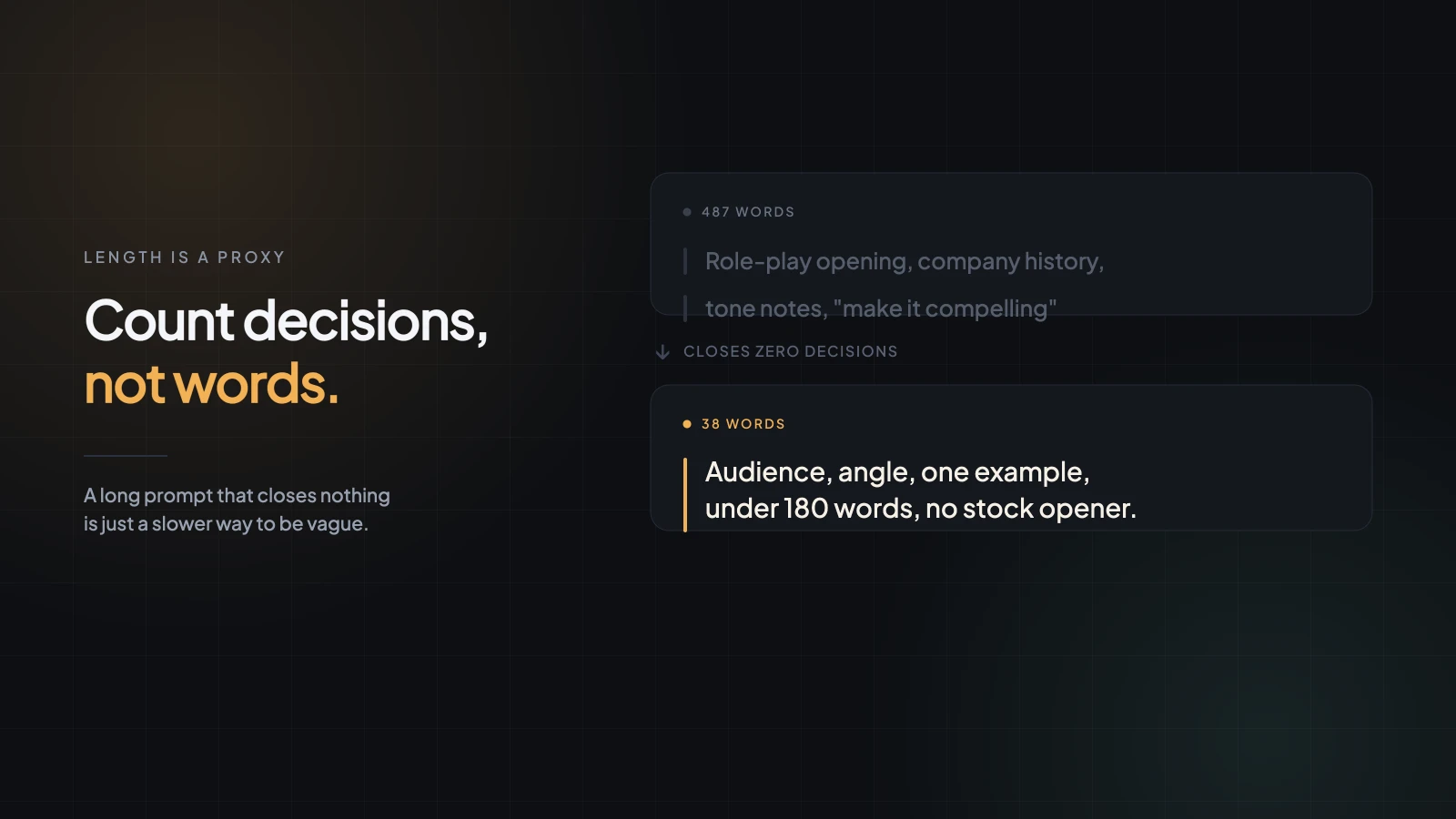
You are an expert copywriter with 15 years of experience in B2B SaaS. I run a company that makes approval workflow software for mid-sized businesses. We've been around four years and we pride ourselves on simplicity and customer service. Our tone of voice is friendly but professional, never salesy, we like to be helpful. I need you to write a really compelling and engaging LinkedIn post that will resonate with our target audience about how AI can help support teams. Make it good and make sure it stands out.
And here's the same request with everything that doesn't change the answer removed. It's the example the complete guide builds from nothing, reached this time by cutting:
Write a LinkedIn post for B2B SaaS founders about using AI to cut repetitive support work. They already use AI, so skip the basics. One concrete example, not a list. Under 180 words. Don't open with "AI is transforming".
A third of the length, and it will outperform the first almost every time. Every sentence in the second version closes a decision. In the first one, the role-play opening, the company history and "make it good" close nothing at all — and "really compelling and engaging" is four words asking the model to decide what compelling means.
The subtraction test
Run this on any prompt you're about to send twice, or any template you reuse.
Take one sentence out. Would the answer be different without it? If the honest answer is no, it was never earning its place. Do that three or four times and most long prompts lose a third of their length without losing anything else.
The sentences that fail this test most reliably: descriptions of your company that don't constrain the output, "you are an expert" openings, politeness aimed at the model, restatements of a requirement you already gave, and any adjective standing in for a decision you didn't make — compelling, engaging, professional, high-quality.
If you only ever apply one habit from this article, apply that last one. Every vague adjective in a prompt is a decision handed back to the model wearing a disguise.
The repair is to swap the adjective for the decision it was hiding. "Compelling" becomes an opening line that names a specific problem. "High-quality" becomes a length and a structure. That's just describing the output, and it usually costs fewer words than the adjective did once you count the rewrites the adjective was going to cause.
When longer really is better
Three cases where more words genuinely help, because the point isn't that short wins.
The material has to be there in full. The email you're replying to, the paragraph you're fixing, the numbers you're analyzing — paste them whole. That's not length, that's the thing being worked on, and summarizing it is what breaks the request.
Examples beat description. Two or three samples of the style you want will take more space than describing the style, and work far better. Showing is longer than telling and worth it.
The task genuinely has many parts. Some requests really do carry eight requirements. When that's true, the answer isn't a longer prompt — it's two prompts in sequence, with the first one's output feeding the second. Splitting beats stacking.
The short version
Stop counting words and start counting decisions. Add a sentence when it would change the answer; delete it when it wouldn't. Paste the material in full, show examples rather than describing them, and split a request that's carrying more than a handful of instructions.
The best prompt isn't the longest one or the shortest one. It's the one where every sentence is doing a job you'd miss if it left.