Constraints sound like a way of getting less. They're the cheapest way to get something specific — and the only reliable way to get real variety.
Ask for three versions of an email and you get three versions of the same email. The greeting changes, one of them says "circling back" instead of "following up", and the third has a slightly warmer sign-off. Three variations, one idea.
The instinct is to push harder: make them more different, really vary them, be creative. That never works, because "different" isn't a direction. The model has no way to know which axis you want them to differ on, so it varies the safest one — wording.
What works is forcing them apart: one under forty words, one that opens by naming the objection, one that doesn't mention price at all. Now they can't converge, because each has been pushed somewhere the others can't follow.
That's what a constraint does. It isn't a restriction on the answer. It's a decision you make once so the model can't duck it.
Constraints are one of the two extensions to the basic method: the thing you reach for once outcome, context and output are in place and the task still needs pinning down.
Constraints are how adjectives get cashed in
Almost every vague adjective in a prompt is a constraint you haven't worked out yet. "Professional" usually means no contractions and no exclamation marks. "Punchy" usually means short sentences and no subordinate clauses. "Accessible" usually means no jargon and an example early.
The adjective is the feeling; the constraint is the mechanism. Naming the mechanism costs about the same number of words and leaves nothing to interpretation, which is the same move as describing the output rather than asking for it to be good.
When you catch yourself typing an adjective, ask what you'd check to know whether the answer had it. Whatever you'd check is the constraint.
Four kinds that pay their way
Size. A number, not a feeling. Under 120 words. Exactly five bullets. Two paragraphs. Size constraints work unusually well because the model can check itself against them as it writes, which most other instructions don't allow.
Vocabulary. What language is allowed. No jargon. No metaphors. Use the words a customer would use, not the words we use internally. This one does more for readability than any instruction about tone.
Structure. What has to appear and in what order. Start with the problem. End with a question. One example per section, never two. Structure constraints are what make output reusable across a week's worth of posts instead of one.
Prohibition. What must not appear. This is the highest-return kind and the one people skip, so it gets its own section.
Name the thing you don't want
Every model has defaults you've silently been editing out for months. The opening that restates your question. The closing paragraph that summarizes what it just said. The em-dash habit. "In today's fast-paced world." The tidy three-item list where two items would do.
You can just ban them. "Don't open by restating the request." "No closing summary." "Never use the phrase 'best-in-class'." Four or five words each, and they hold.
The reason this returns so much is that you're not asking the model to improve something — you're removing a specific behavior. That's a far easier instruction to follow than "make it sound more human", which names a destination without naming a single step toward it.
Keep a running list. Most people need about six prohibitions to cover ninety percent of what irritates them, and once written they get pasted into every prompt for years.
If you don't have one yet, start here and cut whatever doesn't apply to you:
Don't restate my request before answering. No closing summary. No rhetorical questions as section transitions. Don't use "best-in-class", "at the end of the day" or "moving forward". Don't hedge with "it's important to note". If you're unsure about a fact, mark it rather than writing around it.
That's about forty words, and it will do more for your output over a year than most of what people add to their prompts.
One caution: prohibitions accumulate. Review the list every few months and drop the ones you added for a single project. A constraint that no longer matches what you're writing isn't neutral — it's one more instruction competing for the model's attention.
Before and after
The request as it usually gets typed:
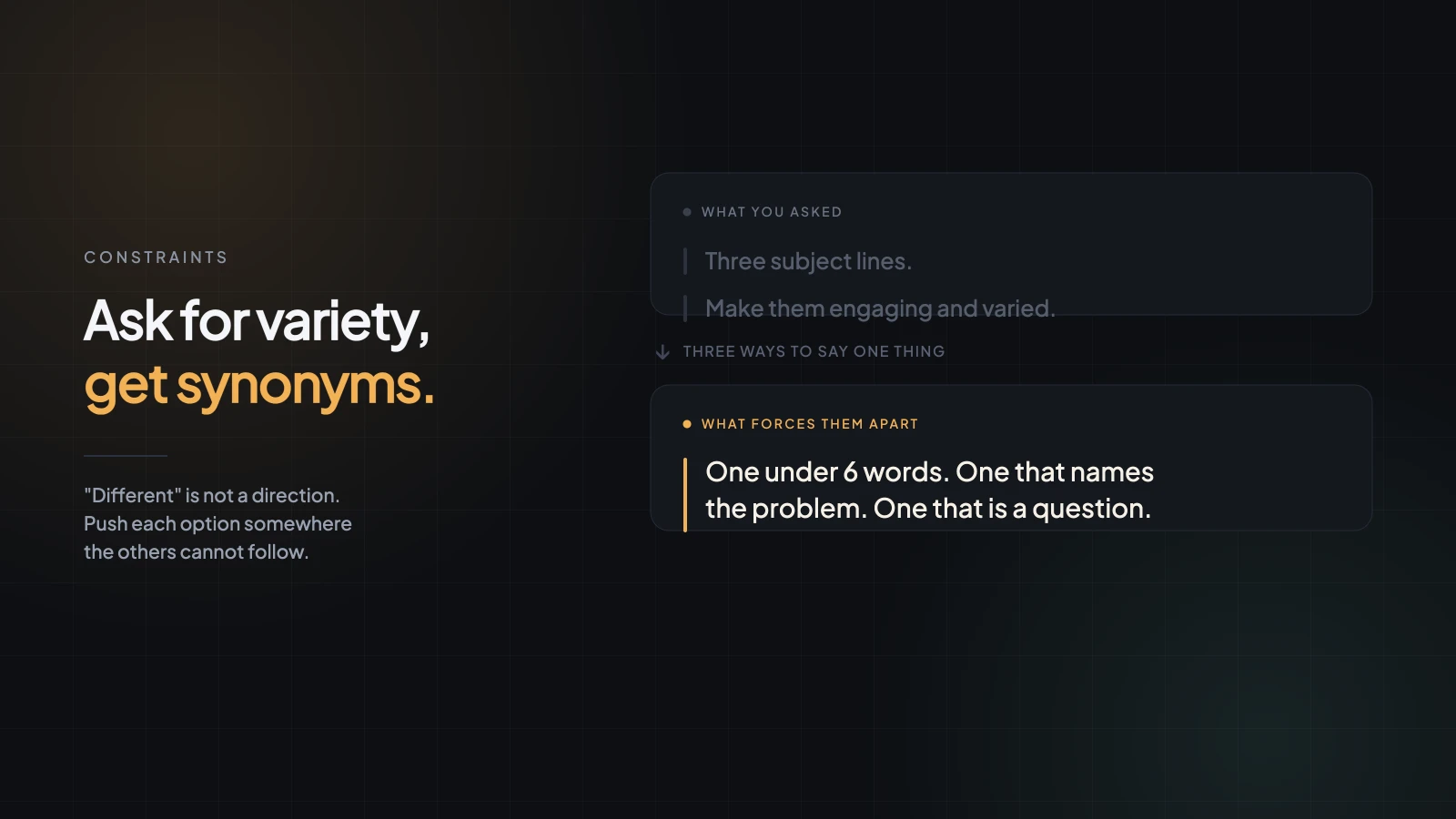
Give me three subject line options for our feature announcement email. Make them engaging and varied.
The same request with the variety forced:
Give me three subject lines for our feature announcement email. One under 6 words. One that names the problem the feature solves, without naming the feature. One that's a question. No emoji, no exclamation marks, and don't use the word "introducing".
Same task, same twenty seconds. The first prompt asks for variety and gets three synonyms. The second one makes variety structurally unavoidable, and the three options that come back are actually worth choosing between.
When constraints go wrong
They contradict each other. This is the most common failure, and it happens because long prompts get written in passes. "Keep it conversational" in one line and "avoid contractions" three lines later. The model will average them and produce something stiff and chatty at once. Read your constraints as a set, not as a list.
They're impossible together. Under 50 words, covering four points, with an example for each. Something has to give, and the model will decide which — silently, and probably not the way you'd have chosen. If a constraint set feels tight, say which one wins: "if you can't fit all four in 50 words, drop the last one."
They constrain the wrong layer. A tightly specified format around an answer with nothing in it is still an answer with nothing in it. Constraints shape what comes out; they can't supply what wasn't there. That's a context problem, and no amount of formatting reaches it.
The short version
Replace adjectives with the mechanism underneath them. Use a number for size, name what vocabulary is allowed, say what has to appear and where, and keep a list of the things you never want to see again.
And when you want genuinely different options, don't ask for variety — make each one impossible to write the same way.